
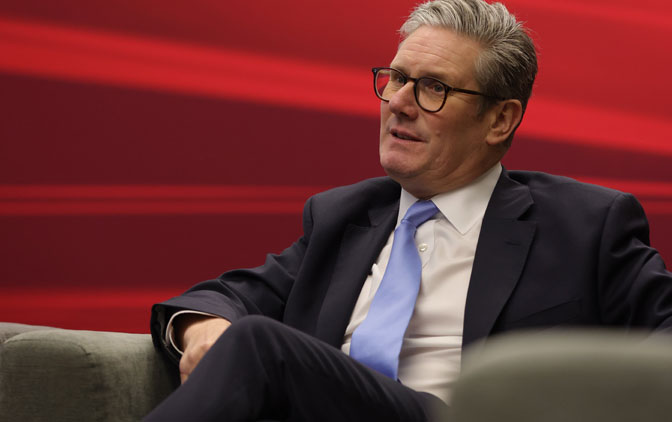
“We’ve created a watchdog state – completely out of whack with the priorities of the British people,” Sir Keir Starmer said in a 13 March 2025 speech at consumer products giant Reckitt’s Hull HQ.
“And it’s unfit for the volatile and insecure world that we live in,” he stated, adding he was committed to “hack back the thicket of red tape that stop us getting things done.”
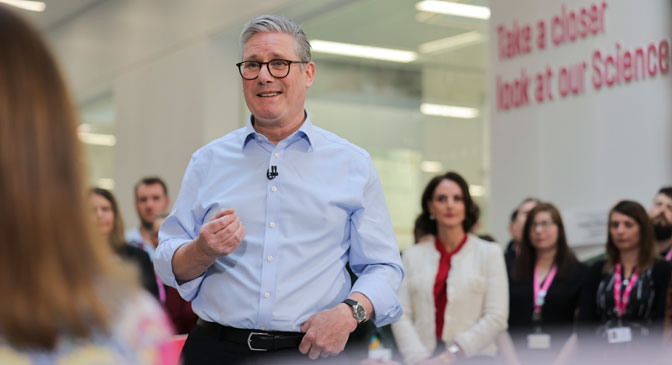 NOT FUNNY The prime minister visited the Hull HQ of Reckitt – the firm behind Dettol, Durex, Harpic and ‘delivering a cleaner, healthier world’ – to say growth and not protective safety, environmental and other business regulation was now his top priority.
It wasn’t regulators who were asked first for their thoughts about Sir Keir’s deregulatory mission. Businesses, investment firms and hedge funds were the first to know. The prime minister told a government-convened investment summit in London on 14 October 2024 “it was time to upgrade the regulatory regime” (Hazards 167).
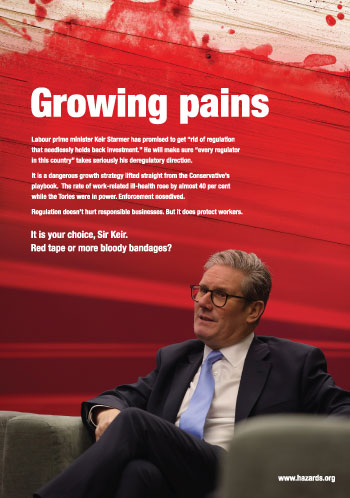
He invited businesses to share their ‘frustrations’ with regulations.
The watchdogs were only brought into the loop on 24 December 2024, when Sir Keir, the chancellor Rachel Reeves and business secretary Jonathan Reynolds wrote to the UK's main regulators asking them to come up with ideas for reform that could boost economic growth.
The letter said the regulatory environment must be made “more pro-growth and pro-investment” while respecting the independence of regulators. It asked regulators to propose by 16 January 2025 “five measurable commitments or changes” they could implement in the next year “within a tolerable level of risk.”
On 17 January 2025 the Health and Safety Executive (HSE) confirmed, after several nudges and three weeks of fudging, it was one of the regulators in the prime minister’s sights. “We can confirm we have received the letter,” a spokesperson told Hazards.
Hazards then asked what HSE was offering up for hacking back and getting back in whack.

LICKSPITTLE LAPDOG When it comes to the Health and Safety Executive (HSE), Keir Starmer’s concern about a watchdog state might be better focused on a lapdog that has pulled its own teeth and turned a blind eye to criminals at work. And HSE's activities are now hidden beneath an unprecedented blanket of secrecy. more
HSE’s sister regulator, the Environment Agency, published its ‘response from the Environment Agency CEO to the Prime Minister’ online and in full on 24 January 2025. The five-page document outlined how it would improve land use planning, its permitting services, data transparency on regulation, support for the government’s approach to strategic spatial planning and for reforming the regulatory framework.
HSE was less forthcoming.
A spokesperson told Hazards: “The fact EA has chosen to publish its response to the PM doesn’t mean HSE or other regulators will be doing the same.”
But HSE is a public body and the information is in the public interest. What HSE does or doesn’t do is important given occupational health and safety can be, quite literally, a matter of life and death for workers. So, Hazards made a freedom of information (FOI) request. It received HSE’s reply on 13 February 2025.
Chilling effect
HSE’s response was a flat ‘no’. “I can confirm that the Health and Safety Executive (HSE) holds information falling within scope of your request,” the FOI response noted.
“However, we are withholding the information from disclosure under Section 35 (1) (a) of the FOI Act (Formulation of Government Policy). This is a qualified exemption that is subject to the public interest test. This means HSE has to balance the public interest factors favouring disclosure against those favouring non-disclosure, which has been explained in the annex at the bottom of this letter.”
The annex noted:
Factors for disclosure
- Promote transparency and building public confidence in HSE’s policy making process.
But transparency and building public confidence were not enough to the sway the regulator, the annex explained.
Factors for withholding
- Protecting the integrity of the policy making process;
- Preserving a safe space to debate live policy issues away from external interference and distraction;
- Preventing a ‘chilling effect’ on free and frank debate in the future and preserving the convention of collective responsibility.
The annex concluded:
Reason why public interest favours non disclosure:
After careful consideration, I believe the public interest in not disclosing the information outweighs the public interest in disclosing, as it would have an adverse impact on the ability of HSE to manage the policy making process.
This leaves a number of unedifying and possibly overlapping possibilities.
HSE places a lower premium on transparency and public confidence than the Environment Agency.
Or the HSE’s proposals will cause such grave offence or concern to sections of the public – those directly affected by HSE’s decisions regarding the protection they expect at work – they might engage in the policy making process in a way HSE would find an unwanted ‘distraction’ and ‘interference’.
The ‘chilling effect’ here was that the working public was frozen out of the ‘free and frank’ process and ‘collective responsibility’ by HSE, a public body formulating public policy which impacts entirely on those expressly excluded from even knowing what HSE was proposing and why.
Slimmed down
It is dangerous times for watchdogs – one, NHS England, has already been axed, others are being merged, the chair of the competition watchdog has been fired for not being focused enough on “growth” and eight, including HSE, met with the chancellor in Downing Street on 17 March 2025 to explain how they will prioritise growth-friendly operations.
In a ‘radical plan to kickstart growth’, Rachel Reeves has promised to significantly cut the number of regulators by the end of the parliament and will “streamline” their core legal duties, which will be “slimmed down”.
The chancellor said she will cut the costs of regulation on business by a quarter. “Today we are taking further action to free businesses from the shackles of regulation. By cutting red tape and creating a more effective system, we will boost investment, create jobs and put more money into working people’s pockets,” Reeves said.
Regulators will be summoned twice a year by the relevant secretary of state – in HSE’s case, the work and pensions secretary – and “will be judged against a set of targets agreed with the businesses they affect.”
It is not just the cost of regulations in the firing line; the regulators are set to be pared back too. Whitehall insiders have told Hazards that HSE will be presented with a substantial budget cut in the Chancellor’s June 2025 Spending Review – despite having far fewer frontline inspectors already than at any time in its history and a record number of workplaces to enforce.
Regulators have been instructed to submit ‘key performance indicators’ by June 2025.
‘A new approach to ensure regulators and regulation support growth’, the government’s Action Plan to reform the regulatory system, has not so far been discussed with unions, workers or the public at large.
So far reviews of the Pressure Systems Safety Regulations 2000 and the Lifting Operations and Lifting Equipment Regulations are on the HSE to-do list.
The plan requires HSE to “consult to identify and remove unnecessary regulatory burdens and identify potential changes to this legislation to reflect technological advances and reliability of work equipment.”
This though is a regulator that didn’t need an invitation to do less, less well.
HSE is not making an impact on fatal and major injuries at work and conducts far fewer inspections so workers can no longer expect to see an inspector in a working lifetime (see: Flatlining).
And it has all but given up on prosecutions of lawbreaking employers when workers are harmed.
Work-related ill-health is stuck at an all-time high of 1.7-1.8 million workers affected, up by almost 40 per cent since 2010. The resulting working time lost has increased from 22 million then to 34 million working days in 2023/24, the most recent figures available.
And HSE refuses to do anything about sexual harassment at work, defends a deadly silica standard and will not investigate or require reporting of work-related suicides.
Healthy workers are essential to growth. Regulation properly enforced and a regulator properly accountable is what makes that happen.
Your safety, your health, HSE’s secret
When it comes to the Health and Safety Executive (HSE), at least, Keir Starmer’s concern about a watchdog state might be better focused on a regulator that increasingly doesn’t watch, listen or act (see: Flatlining).
Secrecy is the new normal for HSE – and it is getting worse. In 2023, a statement regarding HSE board meetings on the regulator’s website noted: “HSE is committed to being open, so we publish the latest meeting agendas, papers and minutes” (Hazards 163).
Only it didn’t. No agendas or papers have been published in advance of meetings since 2016. The papers haven’t been published at all.
After Hazards revealed HSE was no longer meeting its commitment to transparency, the openness statement on its website was revised. “We are committed to being open about what we do,” it notes, but adds “with the exception of business subject to exemptions under the Freedom of Information Act 2000,” with papers and minutes no longer mentioned.
WATCHDOG'S
STATE
The Health and Safety Executive (HSE) has told Keir Starmer how it will strip away the ‘red tape’ that protects your health. But, warns Hazards editor Rory O’Neill, HSE doesn’t want you to know what it told the prime minister – because it says this could have a ‘chilling effect’ on the policy making process.
| Contents | |
| • | Introduction |
| • | Chilling effect |
| • | Slimmed down |
| Related stories | |
| • | Your safety, your health, HSE’s secret |
| Hazards webpages | |
| • | We didn't vote to die at work |